
If you think you can trust how balanced you feel, researchers found something unsettling: you’re probably wrong — and the direction of the error depends on how good your actual balance is. That’s on top of what last week’s piece on the real energy cost of misalignment already covered — this one’s about a different problem entirely.
Coach’s Corner
I go deep on the structural and neurological side of this in an earlier piece — the feet, spine, proprioceptors, all of it. This one’s about something different: the gap between how balanced you feel and how balanced you actually are.
Why You Can’t Trust How Balanced You Feel Without Checking
A 2025 study out of the University of Utah had athletes estimate their own performance on a narrowing balance beam, then compared those estimates to what actually happened. The pattern was clear: people with genuinely poor balance tended to overestimate their ability. People with genuinely good balance tended to underestimate it.
That’s not a small quirk. Roughly a third of older adults misjudge their own balance ability — and the consequences run in both directions. Overestimating leads people to attempt movements beyond their actual stability, which raises fall risk directly. Underestimating leads to unnecessary caution and activity restriction, which — counterintuitively — also raises fall risk, because avoiding movement erodes the very capacity you’re trying to protect.
Even trained athletes, in a controlled study, couldn’t accurately judge their own balance the first time they tried a new task. It took repeated practice on that specific task before their self-perception lined up with reality.
The Test That Reveals Which Category You’re In
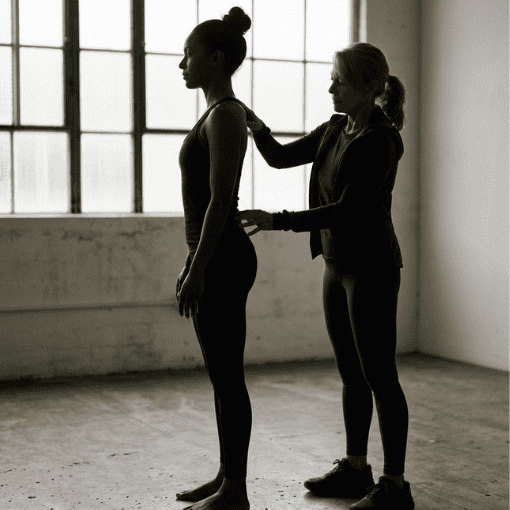
This is exactly why I run a specific test in my studio that requires a second person. You stand straight, close your eyes, lift your toes. I watch for sway — and I don’t correct you back to center. I hold you exactly where your body naturally drifted, using an index finger at T3 and the sternum. I’m not fixing anything. I’m documenting where you actually went.
Then: open your eyes, feet down. I ask — did you move? Which direction?
If you know you swayed, and you know which way, your gravity line might be off, but your awareness is intact. That’s the more fixable problem. But if you genuinely didn’t feel it — or you’re confident you went one way when you actually went the other — that’s not one problem, it’s two. You can’t self-correct something you can’t feel happening.
Where to Start
If you’ve never had this tested, you don’t actually know which category you’re in — and per the research, guessing isn’t reliable. If you want to think through what this might mean for your specific situation before booking anything, ask my AI clone — it’s trained on my actual approach and available anytime, no cost.
Don’t make me come check your form.
Follow the Thread — Where Movement, Fascia, and Freedom Align
Find more insight, reflection, and fascia-informed care:
Leave a Reply