
SI Joint

Joint and Muscle Pain in Active People: Real Solutions

You’re active. You want to stay active. But joint and muscle pain in active people is incredibly common — and frustrating. Especially when you’ve already tried everything: chiropractic care, acupuncture, foam rolling, ART, myofascial release…

And the pain keeps coming back.

Before you chalk it up to “getting older” or “this is just my body now,” there’s one more thing you should try: a root-cause approach that looks at your body as a whole — not just the parts that hurt.

In this post, we’ll break down:

  • The real reasons active people get joint and muscle pain (even when doing all the “right” things)
  • Why most treatments don’t stick — and what your body actually needs
  • What a holistic model looks like — and how to assess yourself

Let’s dig in.
joint and muscle pain in active people

Why Most Treatments Don’t Last

Many people take a linear approach to pain relief. They chase the spot that hurts: knee, shoulder, low back. They get short-term fixes like adjustments, massage, or quick workouts. But they never look at the full picture.

Pain is often a symptom, not the actual problem.

Common band-aids include:

  • Manual therapies that release tension temporarily
  • Strengthening programs that ignore imbalance
  • Stretches that feel good but don’t fix anything long-term

Unless you find and correct the primary root cause, your body will keep compensating. And that’s why the pain comes back.

6 Common Causes of Joint and Muscle Pain in Active People

  1. Overuse Without Balance
    Doing more isn’t always better. Repetitive activity like walking, running, or gardening without balancing out your body leads to breakdown. Your body wants homeostasis — but if you don’t restore symmetry, it starts to hurt.
  2. Unresolved Minor Injuries
    That old ankle roll or back tweak you “walked off”? If it wasn’t re-trained, your body adapted around it. This creates dysfunction and strain elsewhere.
  3. Poor Movement Patterns
    Bad form — even in something as simple as squats or sit-ups — leads to chronic tension and pain. More importantly, your deep stabilizing muscles may be shut off or undertrained, which causes poor control and alignment.
  4. Doing Too Much Too Soon
    Jumping from low activity to high-intensity training (CrossFit, extreme yoga, etc.) without proper progression overwhelms the body. It’s not about the activity — it’s about whether your body is ready.
  5. Dehydration and Stress
    Lack of hydration makes fascia stiff like beef jerky, not supple tissue. Chronic stress keeps you in fight-or-flight mode, locking your muscles and nervous system in a painful loop.
  6. Poor Posture and Body Positioning
    Plumb line off? Gravity line disrupted? SI joint unstable? These are red flags. If your base (pelvis and spine) isn’t in balance, no amount of therapy or exercise will stick.

How to Identify the Real Root Cause

If you want relief that lasts, you must address the primary lesion — the root issue that’s throwing everything else off.

Here’s how to start assessing it yourself:

  • Posture Check: Take a photo from the side. Are your ear, shoulder, hip, knee, and ankle aligned?
  • Movement Observation: Have someone watch you squat, walk, or perform other activities. You may feel “normal,” but your brain often normalizes dysfunction.
  • Activity Review: What do you do most often? What areas of your body are doing the most work? Those overused chains are often the source.

Once you identify a likely root cause, focus on normalizing that area — restoring mobility, strength, awareness, and function. If you choose correctly, many secondary issues will resolve more easily.

Why a Holistic Model Works

The most effective way to resolve joint and muscle pain in active people is to use a holistic model that integrates:

  • Movement assessments (not just static posture)
  • Manual therapy to address fascia, joint alignment, and soft tissue
  • Corrective exercise to restore deep stabilization and proper motor control
  • Lifestyle shifts including hydration, mindfulness, and nervous system regulation

This is how we work at SolCore Fitness & Therapy. We don’t separate the body into disconnected pieces — we work with the whole person.

When we understand your history, how you move, how you’ve adapted, and what’s missing, we can finally address the real issue — not just the symptoms.

Next Steps

You deserve to move, live, and train without nagging pain.

Here’s how to take action:

All the links are in the description. Pick what fits — or try all three.

Building a foundation for a better life.

Find out more @
Facebook

Pinterest

Instagram

Youtube

Osteoporosis AND Bending Over: What’s Safe, What’s Not, and How to Move Better

osteoporosis bending over safety

If you’ve been diagnosed with osteoporosis, chances are you’ve heard some version of this warning: “Don’t bend over you might break your back!” But is it really that simple? What if you drop something, need to garden or vacuum, or want to play with your grandkids? Does having osteoporosis mean you’re forever doomed to a life of restricted movement or is there a more balanced, empowering approach?

[The Ultimate Guide For A Holistic Exercises And Fitness Program]

The Standard Warning and Why It Exists

Osteoporosis thins your bones and makes them more fragile, especially at the spine. Standard advice is to avoid:

  • Forward flexion (bending at the waist with a rounded back)
  • Twisting (especially while flexed)
  • Lifting heavy items with poor body mechanics

The reason is simple: These moves sharply increase compressive forces on your spine, particularly the front part of your vertebral bodies, and this is exactly where bone is most fragile with osteoporosis. In fact, statistics show the majority of osteoporosis-related spinal fractures happen with simple, daily movements—not from falls or accidents. Even something as simple as bending to tie your shoes or pick up a pet can trigger a vertebral fracture if your posture is poor and your bones are weak.

Why This Advice Isn’t the Whole Story

But real life isn’t lived in a bubble. You WILL need to bend, reach, and twist from time to time. And here’s the truth: No two people with osteoporosis are exactly alike. Your risk of fracture is determined by far more than just your diagnosis. It’s about your overall bone density (as measured by your T-score), your history of fractures (or lack thereof), your balance and strength levels, your soft tissue health, your nutrition, and even your hydration and stress levels.

Did you know…?

  • A T-score from −1 to −2.5 is considered osteopenia (lower than average bone mass but not yet true osteoporosis).
  • Osteoporosis is diagnosed at −2.5 or below, and deeper negatives signal greater risk.
  • If you have had a previous spinal fracture, your risk of another is much higher.

What About Everyday Life?

Imagine you have beginning osteoporosis or osteopenia. You still want to hike, garden, travel, and play with your grandkids. Should you be terrified to bend? No! But should you move with greater awareness and make smart modifications? Absolutely.

Let’s break down the top considerations:

  1. Your Bone Density and History
    If your osteoporosis is advanced (lower T-score and/or history of spinal fractures), you must be extra cautious—especially with high-risk, forceful, or repetitive bends. If you’re earlier in the process and otherwise active, movement is critical for maintaining bone and muscle!
  2. Your Current Fitness and Mobility
    How balanced and strong is your body right now? If you have good posture, strong legs and hips, and flexible fascia, you’re already more resilient. If you’re already a little frail, dehydrated, or consistently out of alignment, your risk is higher—and so your plan needs to start with foundations.
  3. Your Technique: Bending Smart
    The key for everyone—regardless of bone density—is learning and practicing safe movement patterns:
  4. Hip hinge, not spine curl: Bend at the hips and knees, sticking your chest out, so your back stays straight and the force is safely absorbed in your larger stabilizer muscles.
  5. Keep movement slow and controlled: No quick, abrupt bends. Avoid bouncing or twisting motions.
  6. Keep weight close to your body: Don’t reach, stretch, and twist while holding something heavy or awkward.
  7. The Power of Whole-Body Training
    Here’s what’s often missing from most online advice: Total body balance, hydration, fascia health, and postural training are all crucial. Balance helps prevent falls. Hydration and soft tissue health support bone health, nutrient delivery, and safe movement.
  8. Training for balance and stability protects you from both falls and spinal stress.
  9. Maintaining your four spinal curves and strengthening your deep core (abs, back, and trunk muscles) disperses forces more safely.
  10. Hydration supports disc “fluffiness” and joint health—reducing spinal compression and painful movements.
  11. You CAN Build (or Re-Build) Bone Strength Safely!
    Safe weight-bearing, resistance, and low-impact exercises (like walking, light resistance, Nordic walking, and gentle yoga—avoiding loaded flexion and twisting) stimulate new bone growth, help you maintain muscle, and boost confidence.
  12. Every Program Must Be Personal
    Your daily routine, goals (hiking, playing, gardening, or just remaining independent), nutrition, supplement needs, and even sleep and stress must be considered together—not just one-size-fits-all rules. If you’re deeper into osteoporosis, all activity should be customized, and for some people, only micro-movements and balance work are appropriate.

Practical “Yes/No” for Bending Over With Osteoporosis

  • Beginning osteopenia, active & balanced: Yes—with good technique, body awareness, and gradual progression.
  • Moderate osteoporosis, no previous fractures, working on fitness & nutrition: Cautious yes, with modifications and under expert supervision.
  • Advanced osteoporosis with previous fractures or other serious risk factors: Very limited—avoid flexion, get expert advice, focus on postural and functional strength, microstimulation, and sustainable movement patterns.

Never try to “push through” pain, round your back under load, or perform high-impact, jerky, or twisting exercises without guidance.

The Bottom Line

Bending over with osteoporosis is NOT an all-or-nothing rule. It’s a nuanced, highly individual decision, and it’s about good technique, foundational strength, and building your resilience over time. Most importantly, it’s about creating balance—throughout your day, your body, and your routine. With the right plan, support, and progression, you can stay strong, independent, and active for life.

it’s not just working out, it’s building a foundation for a better life.

Find out more @
Facebook

LinkedIn

Pinterest

Instagram

Youtube

Bluesky

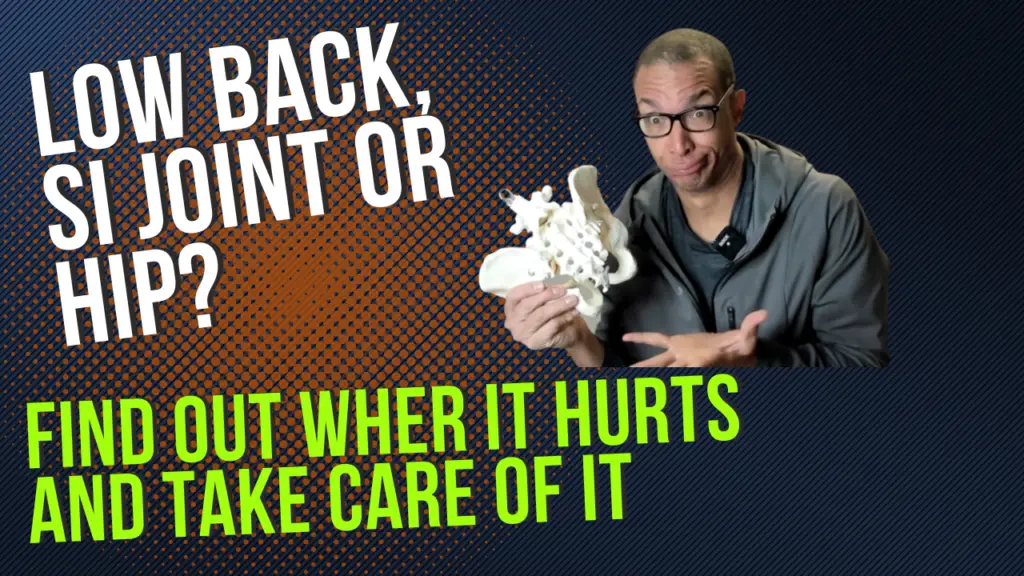
How to Tell if It’s Low Back, SI Joint, or Hip Pain

back pain diagnosis

Click on the image to watch the full video

Ever feel a nagging ache, sharp jolt, or deep stiffness somewhere around your lower back, hip, or pelvis—but can’t tell exactly where it’s coming from? You’re not alone. These areas are interconnected and can easily “refer” pain to each other. Pinpointing the true source is key—since the wrong approach may not only fail to solve your pain, but actually make it worse.

Why Accurate Diagnosis Matters

Each area low back, SI joint, hip has its own causes, pain patterns, and best next steps. Back pain can show up from disc/herniation, strained ligaments, facet joints, or nerve compression, often signaled by pain with bending, twisting, or sitting. SI joint issues cause sharp or aching pain at the dimples above your buttocks, sometimes radiating to the hip or thigh, usually worse with transitions like standing, stairs, or getting up from a chair. Hip pain tends to show deep, achy, or sharp pain in the groin, outer hip, or buttock, and is aggravated by walking, weight bearing, or rotating the leg.

[OMT: Osteopathic Manual Therapy]

Where Does Your Pain Fit?

  • Low Back: Pain between lower ribs and pelvis, worse with bending/lifting, may radiate down into the buttocks or leg (sciatica).
  • SI Joint: Achy, stabbing pain at the upper buttock “dimples,” worse with sitting, stairs, standing from a chair, or rolling in bed.
  • Hip: Deep, aching or sharp pain in front of the groin, outer hip, or buttock, worse walking or rotating the leg, or standing up.

Because these tissues share nerves and muscle attachments, problems frequently overlap. SI joint instability can create tension and pain in both the low back and hip, and vice versa.

What to Do Next

  • Get Assessed Holistically: A great intake includes physical tests, history, movement screening, posture, past injuries, and lifestyle.
  • Prioritize Mobility and Balance: Include corrective exercises for the suspected culprit, but address every link in the chain—muscles, joints, connective tissue, and posture.
  • Integrate Injury Prevention: Pain in these regions can lead to compensation injuries, so proactive balance, core work, and muscle activation are essential.
  • Choose the Right Help: If your symptoms persist, get help from a pro who specializes in holistic, functional movement (not just isolated fixes).

Takeaway:

The right approach starts with locating your pain and understanding your personal pattern. With clear information and targeted training, you can restore efficient movement without setbacks or guesswork.

it’s not just working out, it’s building a foundation for a better life.

Find out more @
Facebook

LinkedIn

Pinterest

Instagram

Youtube

Bluesky

Sciatic Pain Secrets

sciatic pain

Click on the image to watch the full video

Sciatic pain isn’t just a pain in the hip, butt, or leg—it’s a debilitating problem that can take over every aspect of daily life. If you’ve been searching for a cure and nothing works, you’re not alone: the sciatic nerve can be irritated or compressed at many different points, so a generic program will almost never be enough.

Why Formulaic Treatments Fail

Most conventional protocols target one or two common areas: the lumbar spine (disc herniation, bone spurs) or piriformis syndrome. But the real “secret” is that problems can start anywhere along the nerve’s path—from the lower back to the hip, fascial chains, hamstrings, or even the calf. If your care only focuses on one link, you might see little change—or even make things worse.

A Personal Story

Having suffered sciatic pain for years, I went through the checklist: imaging, painkillers, physical therapy, chiropractic care, acupuncture, yoga, pilates, and endless McKenzie exercises. Like many, I found partial, temporary relief—but never truly got my life back until I learned to assess the whole body and embrace a holistic, structure-first approach.

The Real Underlying Causes

  • Nerve root compression: Lumbar disc bulges, herniation, or spinal stenosis pinch the root of the nerve, sending radiating pain downward.
  • Piriformis & fascial entrapment: The nerve can be compressed as it passes through or alongside the piriformis, gluteal, or hamstring muscles, or by tight and fibrotic fascia.
  • Connective tissue “stickiness”: Fascia or scar tissue can tether or irritate the nerve anywhere in its course from the spine to the foot.
  • Other contributors: Poor hydration, poor posture, weak links in the core or lower chain, and poor movement mechanics can all keep the nerve “on edge” even after the initial injury.

What Actually Works

  • Pinpoint the true source of your pain with proper testing—don’t just trust imaging reports. Functional nerve tests and hands-on evaluations unveil what really needs work.
  • Address the whole kinetic chain:
  • Stretch and normalize not just the low back or piriformis, but also the glutes, hamstrings, and calf muscles (especially in cases where the sciatic nerve gets “tethered”).
    • Use mobility training, fascia-focused techniques, and segmentally-strong corrective exercises to restore healthy nerve gliding.
  • Stay patient and persistent: The longer pain has been present, the deeper the compensation and the longer re-education will take. Good “hurts” (tightness, stretch, mild ache from exercise) are necessary; avoid sharp, worsening zaps or numbness.
  • Holistic support matters: Hydration, sleep, mindful movement, and stress management are all essential for full nerve recovery and prevention of relapse.

[Fascia Normalization: Fascia Massage]

If you’re exhausted by “recipe” approaches and want truly personalized help, book a diagnostic call. We’ll uncover where your stuck points really are, create a sustainable plan, and help you reclaim real mobility and comfort.

it’s not just working out, it’s building a foundation for a better life.

Find out more @

Facebook

LinkedIn

Pinterest

Instagram

Youtube

Bluesky