
Women’s Health

Self-Care for Better Relationships: The Valentine’s Gift That Keeps Giving

self-care for better relationships

Valentine’s Day gets reduced to flowers, chocolates, and dinner reservations. But here’s the truth nobody talks about “self-care for better relationships”: you can’t show up for the people you love when you’re running on empty.

That chronic lower back pain? The stiffness that makes you irritable? The fatigue that leaves you too drained for your kids?

That’s not just affecting you. It’s affecting everyone around you.

This Valentine’s Day, let’s talk about real love—the kind that starts with taking care of yourself so you actually have something to give.

Why Self-Care Isn’t Selfish—It’s Required

You know the airplane oxygen mask rule: secure yours first before helping others.

Your body works the same way.

When Pain Controls Your Energy and Mindset

When your fascia is restricted and you’re compensating through every movement, your nervous system operates in constant low-level stress. You’re irritable. Exhausted. Operating at half capacity.

But here’s what most people miss: a dysfunctional body creates a negative worldview.

Bad posture isn’t just physical—it’s mental and emotional. Research shows that good posture allows the body to move more efficiently, use less energy, and create a better body-mind connection. When your structure is collapsed and your spine is compressed, you can’t take a full breath. Your diaphragm doesn’t work. Your nervous system stays locked in stress mode.

The result? The world feels harder than it actually is. Everything seems like a struggle because your body is struggling just to maintain basic function.

All Your Energy Turns Inward

When you’re managing chronic pain or dysfunction, all your focus turns inward. You’re protecting injured areas. Compensating around restrictions. Managing discomfort.

There’s no bandwidth left for anyone else.

You think you’re “powering through” for your family. But you’re giving them a diminished version of yourself—and seeing the world through a filter of discomfort that colors every interaction.

Taking care of your body flips this dynamic completely.

When you address fascial restrictions, decompress your spine, and move without compensation:

  • Energy flows outward again instead of being consumed by pain management
  • You have capacity for your partner, your kids, your friends
  • You see possibilities instead of obstacles
  • You show up with patience instead of irritation
  • The world stops feeling like such a grind

The version of you that feels good in your body is a better partner, parent, friend, and colleague. Period.

From “I” to “We”: How Fixing Your Body Helps Your Inner Circle

Here’s what happens when you prioritize self-care for better relationships:

Your partner notices you’re less grumpy in the morning. You don’t wince getting up from the couch. You have energy for evening walks again.

Your kids notice you can play without wincing. You’re not constantly saying “not right now, my back hurts.”

Your friends notice you’re actually available instead of canceling plans because you’re too sore.

Real Change: Amber’s Story

Amber, a 45-year-old accountant who practiced yoga, hiked, and traveled, developed low back and SI joint problems. The therapist she’d been seeing for decades couldn’t fix it.

She tried everything—yoga (which she thought would replace physical therapy), rolfing, chiropractic, acupuncture, diet changes. Temporary relief, but nothing stuck.

Here’s what was actually happening: her therapist didn’t understand how to support her with exercises and wasn’t educated on the different areas of the SI joint. He was chasing symptoms instead of addressing the fascial system.

At SolCore, we gave her the right exercises for her structure. Not generic PT protocols—exercises based on how her fascia was actually restricted.

She became consistent with the homework. Started feeling better.

Then with one in-person treatment using osteopathic manual therapy? Pain gone.

Why? Because we addressed the system, not just the symptom.

Now Amber can show up for her work without distraction. She can hike and travel. She has capacity for volunteer work she cares about. Her partner got the engaged, active version of her back—not the one constantly managing pain.

[Read Amber’s full story →]

When you fix your own body, the people closest to you benefit immediately. That’s not abstract—that’s how relationships actually work.

From “We” to “Us”: The Community Ripple Effect

Social connections and support networks are essential for maintaining independence and well-being. But when you’re stuck in pain and dysfunction, you withdraw. You can’t volunteer. You can’t show up for community events. You don’t have capacity to help others.

When your body works properly, you can participate again.

How Self-Care for Better Relationships Extends Beyond Your Home (H3)

Your coworker notices you’re not constantly complaining about pain. They ask what changed. You share what actually worked.

Your neighbor sees you moving better. Asks how you fixed your shoulder. You point them toward real solutions.

Someone at the coffee shop mentions chronic back pain. You can actually help instead of just commiserating.

This isn’t about being evangelical—it’s what happens naturally when you experience real change.

People notice. They ask. You share.

And suddenly, the decision to take care of yourself—the one that seemed “selfish” at first—has impacted dozens of people you’ll never even know about.

What Real Love Actually Looks Like

Real love isn’t about grand gestures on February 14th.

It’s about:

  • Having energy to be present for your partner
  • Being able to play with your kids without pain
  • Showing up for friends instead of canceling plans
  • Contributing to your community instead of just surviving
  • Seeing the world as full of possibility instead of obstacles

All of that starts with taking care of your body. Not “someday.” Now.

Because the people you love deserve the best version of you. And you can’t give them that version when you’re operating from restriction, compensation, and chronic discomfort.

Because your community needs you showing up, not withdrawing.

Because the world needs people who have the capacity to help others—and that capacity starts with a body that functions.

Ready to Start Your Self-Care Journey?

If You’re in Santa Fe

Our Kickstart programs give you the foundation—private assessment, group classes, or personalized sessions addressing your specific fascial restrictions and compensation patterns.

Not a generic fitness program. A system designed around how your body actually works.

If You’re Outside Santa Fe

Book a free consultation. We’ll discuss what’s happening with your body, what you’ve tried, and whether our approach makes sense for your situation.

We also offer online programming for people who can’t train with us in person.

The Bottom Line

You can’t pour from an empty cup. You can’t help others when you’re barely holding it together.

Taking care of your body isn’t selfish. It’s the most loving thing you can do—for yourself, for your family, for your community, for everyone who needs you to show up.

This Valentine’s Day, give yourself the gift that keeps giving.

Fix your body. Help your people. Change your world.

Follow the Thread—Where Movement, Fascia, and Freedom Align

Find more insight, reflection, and fascia-informed care:

Facebook

Bluesky

Pinterest

Instagram

YouTube

LinkedIn

Winter Stiffness: Why Cold Weather Hurts (And How to Fix It)

Welcome to winter stiffness. And no, you’re not imagining it.

It’s January. Welcome to winter stiffness. You wake up, swing your legs out of bed, and everything feels… tight. Your back is stiff. Your shoulders are locked. Movement that felt fine in September now feels like you’re pushing through molasses.

Why Your Body Feels Stiffer When It’s Cold

Cold weather affects your fascia—the connective tissue web that wraps every muscle, connects your entire body, and coordinates movement.

Fascia is made primarily of collagen fibers suspended in a gel-like substance called ground substance. When temperatures drop, this ground substance becomes more viscous. Think of honey in the refrigerator—it thickens, flows less easily, and resists movement.

That’s what’s happening inside your body.

Your fascia loses its fluidity. Tissues that should glide smoothly start sticking. Areas that were already restricted become more compressed. And suddenly, everything hurts.

Add to this the fact that most people move less in winter. You’re not hiking as much. You’re not gardening. You’re spending more time sitting indoors. Less movement means less fluid flow through your fascial system, which means more stiffness.

It’s a cycle: cold weather restricts fascia → you move less because it hurts → less movement creates more restriction → you feel worse.

What Actually Works for Winter Stiffness

If you want to feel mobile in winter, you need to restore fluid flow and tissue quality in your fascial system. Here’s how:

1. Active Warming Before Movement

Don’t jump into stretching or exercise cold. Spend 5-10 minutes doing gentle, full-body movement first. Arm circles, leg swings, spinal rotations. Nothing intense—just enough to increase circulation and warm tissues from the inside.

Your fascia needs to be warm to move properly. This isn’t optional.

2. Myofascial Stretching

Unlike static stretching, myofascial stretching works with your fascial chains—the connected lines of tissue that run through your entire body. These stretches are active, full-body, and designed to restore fluid flow and tissue glide.

For example, instead of just stretching your hamstring, you’d work the entire posterior chain from your foot through your calf, hamstring, glutes, and back. That’s how fascia actually functions.

Learn more about myofascial stretching here.

3. ELDOA for Spinal De-coaptation

Winter stiffness often shows up in the spine first. Your vertebrae compress, discs lose space, and suddenly your back feels locked.

ELDOA (spinal de-coaptation exercises) creates space in specific segments of your spine, restoring fluid flow and reducing compression. These aren’t passive—they require active engagement and precise positioning.

But when done correctly, they work. Fast.

4. Keep Moving (Even When You Don’t Want To)

The worst thing you can do in winter is stop moving. Your fascia needs movement to stay hydrated and functional.

You don’t need to train hard. But you do need to move daily. Even 15-20 minutes of intelligent, fascia-focused work makes a massive difference.

5. Hydration

Cold weather makes you less thirsty, but your fascia still needs water. Dehydrated fascia is stiff fascia. Drink water consistently throughout the day, even if you don’t feel like it.

Coach’s Corner: The Winter I Learned This Lesson

Years ago, I trained outside year-round. Santa Fe winters aren’t brutal, but they’re cold enough.

I noticed that my clients who only came to class in spring and summer would show up in January completely locked up. Their bodies had lost all the progress they’d made.

Meanwhile, the clients who stayed consistent through winter? They felt better than ever. Not because winter was easier for them—but because they kept moving intelligently through it.

That’s when I realized: winter stiffness isn’t inevitable. It’s a choice.

You can let cold weather shut you down, or you can adapt your approach and keep your body functional.

What to Do This Week

Here’s your challenge: spend 15 minutes every morning this week doing active warm-up and myofascial stretching before you start your day.

Notice how your body feels. Notice how movement changes when you prepare properly.

If you want guidance on exactly what to do, our group classes and private sessions are designed for this. We work with fascia, not against it. And we keep people moving year-round.

Book a free consultation and let’s talk about how to keep your body functional this winter.

Or try one of our free monthly ELDOA classes and experience spinal decompression firsthand.

Winter doesn’t have to hurt. You just need the right approach.

Follow the Thread—Where Movement, Fascia, and Freedom Align

Find more insight, reflection, and fascia-informed care:

Facebook

Bluesky

Pinterest

Instagram

YouTube

LinkedIn

January Doesn’t Care About Your Plans (But Your Body Does)

Active woman in her 60s performing rotational lunge exercise, demonstrating focused effort and functional movement training"

New year fitness goals hit different when you’re not starting from scratch—when you’ve been training for years, stayed active through the holidays, and still can’t shake fitness plateaus, the stiffness in your lower back, or the weakness that showed up somewhere between Thanksgiving and now.

You’re not a resolution warrior scrambling for motivation. You’ve been moving. You’ve been consistent. So why does your body feel worse?

Here’s the truth: that fitness plateau you hit six months ago? The compensation pattern you’ve been ignoring? The fascial restriction that makes your hip feel like concrete? The holiday break didn’t cause them. It just made them impossible to ignore.

And January’s fresh energy? It’s not about starting over. It’s about addressing what’s been holding you back all along.

Coach’s Corner: What My Body Told Me in January

I came back from the holidays expecting to pick up where I left off. My training schedule was light but consistent. I stayed active. I didn’t completely abandon my routine.

But that first week back? My body had other plans.

The stiffness I’d been “managing” suddenly demanded attention. The compensation pattern I’d been working around stopped cooperating. And that movement that used to feel effortless? It wasn’t anymore.

Here’s what I realized: the break didn’t break me. It just removed the momentum that was masking the dysfunction.

And that’s actually good news. Because now I could see what needed fixing.

The Fitness Plateau You Didn’t See Coming

Active people hit walls too. You’re training. You’re stretching. You’re doing everything you’re supposed to do.

But progress stopped months ago. You’re maintaining, not improving. And lately, even maintaining feels harder.

This is what a fitness plateau looks like for people who actually move:

  • You can still do your workouts, but they feel heavier than they should
  • Flexibility isn’t improving no matter how much you stretch
  • Strength gains flatlined despite consistent effort
  • Recovery takes longer than it used to
  • Stiffness shows up in places it never did before

You’re not lazy. You’re not unmotivated. You’re stuck. And the holiday slowdown just made it obvious.

What the Break Actually Revealed

When you’re in constant motion, it’s easy to work around dysfunction. You compensate. You adjust. You find ways to keep moving even when something isn’t working right.

But when you slow down—even slightly—those compensation patterns stop holding.

Here’s what the break revealed:

Fascial restrictions you’ve been ignoring. That tight hip? It’s not a muscle. It’s layers of fascia that haven’t moved properly in months (maybe years). Basic stretching won’t fix it. You need de-coaptation mobilization and progressive loading that works with the tissue, not against it.

Movement patterns that stopped serving you. You’ve been doing the same routine for so long that your body has found the path of least resistance. And now? You’re reinforcing dysfunction instead of building capacity.

Compensation strategies that finally hit their limit. Your shoulder took over for your weak rotator cuff. Your lower back compensated for your restricted hips. Your body is brilliant at adaptation—until it isn’t.

The plateau isn’t a failure. It’s information.

Small Corrections, Big Results (Why Heroic Effort Fails)

Here’s where most people go wrong in January: they try to out-work the problem.

More reps. More intensity. More classes. More miles.

But if your body is stuck in a compensation pattern, more volume just reinforces the dysfunction. You’re building fitness on top of a faulty foundation.

What actually works: strategic corrections.

Instead of heroic effort, focus on intelligent inputs:

Address the fascia. ELDOA creates space in your spine and joints. Myofascial stretching restores tissue mobility. These aren’t “stretches”—they’re corrective techniques that change how your body organizes itself.

Build segmental strength. Weakness isn’t always systemic. Sometimes one joint, one segment, one area isn’t doing its job. Segmental strengthening targets those gaps so your whole system can function better.

Work with progression, not intensity. Your body doesn’t need more. It needs better. Small, consistent corrections compound. That’s how you break through a fitness plateau without burning out.

How to Use January Without the Pressure

January has energy. Use it. But don’t weaponize it against yourself.

You don’t need a transformation. You need strategic adjustments that let your body do what it’s been trying to do all along: move well, recover efficiently, and build capacity without compensation.

Here’s how:

Audit your current state. Where are you actually stuck? What movement feels harder than it should? What limitation keeps showing up no matter what you do?

Address restriction before loading it. If your hip is restricted, strengthen something else first. If your shoulder compensates, mobilize before you load. Structure dictates function—fix the structure first.

Make one correction at a time. You don’t need to overhaul everything. Pick the thing that’s holding you back the most and address it. Progress compounds.

Use the momentum, not the pressure. January feels fresh because you had a break. That rest wasn’t wasted time—it gave your nervous system space to reset. Now use that clarity to make smarter decisions, not harder ones.

Where to Start

If you’re reading this and thinking, “That’s me. I’m stuck. I’m active but not improving. I’m moving but limited”—you’re not alone.

And you don’t have to figure it out by yourself.

This is what we do at SolCore Fitness & Therapy: we work with active people who hit walls. People who’ve been training for years and suddenly can’t break through. People whose bodies are telling them something needs to change, but they don’t know what.

We map it out. We address the restrictions, correct the patterns, and build the capacity your body’s been asking for.

No generic programs. No one-size-fits-all protocols. Just intelligent, fascia-focused, osteopathically grounded training that meets you where you actually are.

Book a free consultation and let’s figure out what’s holding you back. Or explore our approach and see how fascia-focused training creates change that lasts.

January doesn’t care about your plans. But your body does. Let’s listen to it.

Follow the Thread—Where Movement, Fascia, and Freedom Align

Find more insight, reflection, and fascia-informed care:

Facebook

Bluesky

Pinterest

Instagram

YouTube

LinkedIn

Why Body Awareness Training Matters More Than Any Exercise Program

body awareness training

Body awareness training isn’t about learning more exercises. It’s about learning your body’s language—and that skill is worth more than any workout I could ever give you.

Most people come in wanting a prescription. Tell me what’s wrong. Give me the exercises. Fix me.

I get it. You’re busy. You want results. You trust experts to have answers.

But research on therapeutic exercise adherence shows that understanding your body’s signals matters as much as the exercises themselves. When you only want exercises, you stay dependent. You need me to tell you what to do next week, next month, next year. And your body? It never gets a vote.

COACH’S CORNER

I’ll confess something: my favorite clients aren’t the ones who follow instructions perfectly. They’re the ones who ask, “Why does this feel different today?” or “Should I be feeling this in my hip?”

Those questions tell me they’re paying attention. They’re developing body literacy. And that means eventually, they won’t need me as much—which is exactly the point.

The “Give Me Three Exercises” vs Body Awareness Training Problem

When you only want exercises, two things happen:

You create dependence. You need someone else to tell you what to do. Every time something changes—new pain, different schedule, injury—you’re back at square one waiting for instructions.

You ignore context. Your body changes day to day. What you needed Monday might not be what you need Friday. But if you’re blindly following a program, you miss those signals.

Body awareness training flips this. Instead of following, you learn to listen.

What Body Literacy Actually Looks Like

Body literacy means reading your body’s signals. You learn the difference between:

Protective pain (sharp, acute, “stop now”) vs. adaptive discomfort (challenging but tolerable, “this is new but manageable”)

Fatigue (rest needed) vs. lack of challenge (time to progress)

Restriction (needs addressing) vs. natural limitation (needs respect)

This isn’t abstract. It’s practical. And it’s exactly what we teach in our holistic exercise program.

Marja, one of my long-time clients, came in years ago confused by every exercise. She needed constant cuing, constant correction. She’d ask, “Am I doing this right?” every thirty seconds.

Now? She feels it. When I introduce a new stretch, she knows within seconds if she’s positioned correctly. She adjusts without me saying a word. She’s become her own best therapist.

“At my age,” she says, “this brain-body connection is incredibly important.”

She’s right. And she’s not special—she just practiced paying attention.

Why This Matters for Long-Term Success

When you develop body awareness training, you:

Know when to push and when to back off. You don’t need someone else to tell you if you’re overdoing it. You feel it. You adjust.

Catch problems early. You notice restriction, compensation, or dysfunction before it becomes pain. Prevention beats treatment every time.

Understand why something works. You’re not following a recipe—you’re learning principles. That knowledge transfers to everything you do.

Adapt when life changes. New injury? Different schedule? Aging body? You don’t need a whole new program. You adjust what you know.

This is empowerment. Not dependence.

The “Give Me Exercises” Trap

Here’s what happens when you only want exercises:

You do them for a while. They help. Then life gets busy. You stop. The problem comes back. You need new exercises. The cycle repeats.

You never learned why your body responded. You never developed the skill of listening. You never became your own guide.

Exercises are tools. Body awareness is the skill.

Without the skill, the tools are useless. With the skill, you can use any tool effectively.

What This Means for You

If you’ve been dependent on practitioners to tell you what to do, this is why you’re stuck.

If you keep coming back with the same problem, this is why.

If you feel lost when you don’t have someone guiding you, this is why.

Your body is speaking. You just need to learn its language.

And once you do, everything changes.

Body Awareness Training – Start Listening

Body awareness training doesn’t happen overnight. It takes practice, patience, and presence.

But it’s the difference between renting your health from experts and owning it yourself.

Want to start developing body literacy? Try this:

Next time you do any exercise—whether it’s one of mine or something you found online—ask yourself:

  • What do I feel? (Be specific. “My left hip” beats “somewhere down there.”)
  • Is this protective pain or adaptive discomfort?
  • What would happen if I adjusted slightly?

That’s body awareness training. Three questions. Every exercise. Over time, you’ll stop needing me to tell you what’s working.

And that’s the whole point.

Ready to learn your body’s language? Book a free consultation and let’s start building body literacy, not just strength.

Follow the Thread—Where Movement, Fascia, and Freedom Align

Find more insight, reflection, and fascia-informed care:

Facebook

Bluesky

Pinterest

Instagram

YouTube

LinkedIn

Why Quick Fixes Fail (And What Real Progression Looks Like)

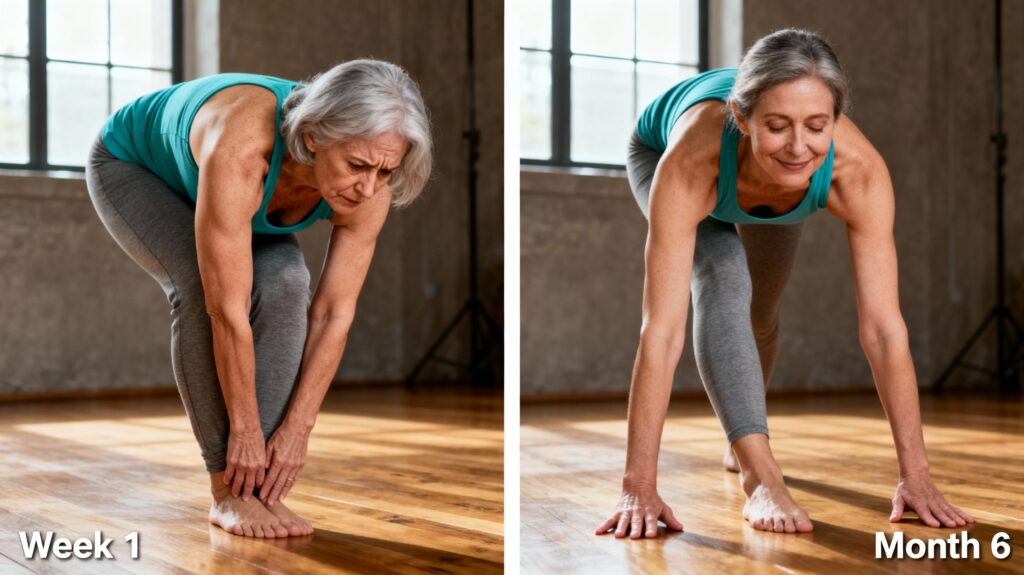
Why quick fixes fail. Image of woman in her 60's showing how it takes time with progression fascia training.

Quick fixes fail. Every single time.

Quick fixes will only lead to frustration or hurt quickly.

“Six weeks to a pain-free back.”

“Transform your body in 30 days.”

“Three exercises to fix your shoulder.”

These promises are everywhere. And they’re physiologically impossible.

If only your fascia could read marketing copy, it might actually remodel that fast.

Coach’s Corner

Marja came to me after breaking three vertebrae. Doctors said she’d never garden again—her favorite activity.

She didn’t accept that.

But she also didn’t expect miracles. She understood that rebuilding a body after that kind of trauma takes time.

Years later? She’s pain-free, gardening regularly, and moving better than she did before the injury.

Watch her full video interview to see what real progression looks like.

The Quick-Fix Culture Problem

We live in a culture that sells speed. Six-week programs. 30-day challenges. Weekend workshops that promise to “reset” your body.

And I get it. You’re in pain. You want relief. You want it now.

But here’s the truth most practitioners won’t tell you: your body doesn’t work on a marketing timeline.

Tissue adaptation is a biological process. It has a pace. You can’t hack it, shortcut it, or Instagram it into happening faster.

You can only respect it or ignore it.

And when you ignore it by chasing quick fixes, you get temporary relief followed by the same problem—or a new one.

Why Tissue Takes Time

Let’s talk about what actually happens when your body adapts.

Acute pain relief: Can happen quickly (days to weeks) with the right intervention. This is inflammation decreasing, nervous system calming, immediate restrictions releasing.

Movement pattern changes: 4-8 weeks of consistent practice. This is your brain learning new motor patterns, your nervous system rewiring compensation habits.

Tissue remodeling: 3-6 months of progressive loading. This is fascia reorganizing its collagen structure, muscles adapting to new demands, joints stabilizing differently. Research shows that skeletal muscle ECM turns over approximately 0.5-2% of its collagen per day—meaning complete remodeling takes months, not weeks.

Structural integration: 6-12+ months of sustained work. This is your entire system learning to function differently—not just one area, but how everything connects. This is what holistic exercise and fitness programs are designed to address—the whole system, not just isolated parts.

Quick fixes might give you the first one. Temporary relief.

But they skip the rest. And that’s why the problem returns.

The Difference Between Relief and Change

Relief is what you feel when inflammation goes down or a muscle releases.

Change is what happens when your body learns a new pattern and maintains it.

Most programs sell relief and call it change.

You feel better for a few weeks. The pain comes back. You need another program. The cycle repeats.

This isn’t healing. It’s symptom management.

And there’s nothing wrong with symptom management—sometimes you need relief to function. But if you stop there, you’re not building anything that lasts.

Real change requires progression. And progression takes time.

What Progression Actually Looks Like

Ashley came in limping with plantar fasciitis. Within weeks, she was pain-free.

That sounds like a quick fix. But here’s what actually happened:

Week 1: Myofascial release and manual therapy addressed the immediate restriction. Pain dropped significantly. This was relief.

Weeks 2-4: Exercises that progressively loaded her foot, ankle, and lower leg. Her nervous system learned it was safe to move again. This was pattern change.

Weeks 4-8: Continued loading and integration work. Her fascia began remodeling. The change started becoming structural.

Months 2-3: Maintenance and refinement. The new pattern became default. This was lasting change.

If she’d stopped at week 1 when the pain went away, it would have come back. The relief was real, but the change wasn’t complete yet.

That’s the difference between a quick fix and progression.

The Compound Effect

Small, consistent improvements stack.

A 1% gain repeated over months becomes transformational.

This is how you:

  • Eliminate pain that’s been around for years
  • Restore mobility you thought was gone
  • Build strength that transfers to real life
  • Create resilience that prevents future injury

Not in 6 weeks. In 6 months. 12 months. A lifetime of practice.

And here’s what’s interesting: the people who understand this get better results faster than the people chasing speed.

Because they show up consistently. They trust the process. They don’t bail when week 3 isn’t Instagram-worthy.

Why Quick Fixes Always Fail

Quick fixes fail because they don’t address the system. They target symptoms.

Your shoulder hurts. They give you three shoulder exercises.

But your shoulder doesn’t hurt because it’s weak. It hurts because your thoracic spine is restricted, your scapula isn’t moving properly, and your fascia has been compensating for years.

Three shoulder exercises might make it feel better temporarily. But they don’t address why it started hurting in the first place.

So six weeks later, it’s back. Or your neck starts hurting. Or your elbow acts up.

This is how you end up chasing symptoms for years.

The system is still broken. You’re just moving the problem around.

The “Just Tell Me What to Do” Problem

Most people want a prescription. “Just tell me what exercises to do.”

I understand. You’re busy. You want efficiency.

But here’s the issue: your body isn’t static. What you need today might not be what you need next week.

If you’re only following instructions without understanding why, you can’t adapt when things change.

This is why so many people do PT, feel better, then stop—and six months later, they’re back where they started.

They got exercises. They didn’t get education.

They got relief. They didn’t get ownership.

What Real Progression Requires

1. Time

There’s no way around this. Tissue remodels at its own pace. You can optimize it, but you can’t force it.

2. Consistency

Showing up matters more than intensity. Three focused sessions a week beats one heroic effort followed by two weeks off.

3. Progression

You can’t do the same thing forever and expect different results. Load has to increase. Complexity has to advance. Your body has to be asked to adapt.

4. Awareness

You need to learn what your body is telling you. What’s protective pain vs. adaptive discomfort. When to push and when to back off.

5. Patience

Not the passive kind. Active patience. Trusting the process while staying engaged with it.

This isn’t sexy. It doesn’t fit on an Instagram post. But it works.

And it lasts.


The Three-Month Reality Check

I tell new clients: give me three months of consistent work before you decide if this is working.

Not because nothing happens before that. Often, relief comes quickly.

But real change—the kind that lasts—takes about three months to start showing up structurally.

After three months of consistent fascia-focused training:

  • Movement patterns have started to shift
  • Compensation habits are beginning to release
  • Tissue is remodeling
  • Your nervous system trusts the new patterns

This is when people say: “I move differently now. I feel different in my body.”

Not after six weeks. After three months.

And if you want that change to be permanent? Keep going for another three. And another three after that.

It’s easier to sell quick fixes than real progression.

It’s easier to promise “pain-free in 6 weeks” than to say “this will take months, and it won’t always feel good.”

It’s easier to give people three exercises than to teach them to understand their own bodies.

But easy doesn’t work.

If rest and quick fixes solved chronic pain, you wouldn’t still be dealing with it.

If six-week programs created lasting change, you wouldn’t need a new program every few months.

The way forward is slower. But it’s also the only way that actually gets you there.

What Changes When You Embrace Progression

When you shift from chasing quick fixes to trusting progression:

You stop panicking when pain shows up. You understand it’s information, not an emergency.

You stop bouncing between programs. You commit to one approach long enough to see if it works.

You stop chasing symptoms. You address the system creating them.

You build something that lasts. Not just relief, but real change.

This is what holistic training actually means. Not quick. Not easy. But effective.

And permanent.

Ready to Build Real, Lasting Change?

If you’re tired of quick fixes that don’t last, this is why.

Your body needs time, consistency, and intelligent progression.

Want to go deeper? Download The Fascia Fix Framework—a free 20-page guide covering all 5 principles missing from most fitness and therapy programs.

Local to Santa Fe? Book a free consultation to discuss whether SolCore’s progression-based approach is right for you.

See what real progression looks like: Read Ashley’s case study—how she went from not being able to walk, back to her active self.

Questions? Contact us at info@solcorefitness.com or call (505) 577-2171.

Follow the Thread—Where Movement, Fascia, and Freedom Align

Find more insight, reflection, and fascia-informed care:

Facebook

Bluesky

Pinterest

Instagram

YouTube

LinkedIn

The Way Is Through: Why Your Body Needs Challenge, Not Comfort

fascia training challenge

Your body doesn’t avoid pain. It protects against it.

And when you spend years protecting—resting, avoiding, icing, stretching gently, never pushing—you don’t heal. You create a fortress of compensation that feels safer but moves worse.

This is the fundamental misunderstanding behind most injury recovery and fitness approaches: the belief that comfort equals healing.

It doesn’t.

Healing requires challenge. Intelligent, progressive challenge that teaches your body it’s safe to move again.

Coach’s Corner

Amy came to me at 68. Retired. Exhausted.

She thought “just moving” was enough.

It wasn’t.

Three months of fascia-focused training later, the aches were gone.

Today? She’s 70 and learning archery in Bhutan.

Download her full case study to see exactly what changed.

The RICE Protocol Failed You

Rest. Ice. Compression. Elevation.

For decades, this was the gold standard for injury management. And for acute trauma—a broken bone, a severe sprain in the first 24-48 hours—it has its place.

But for chronic pain? For movement restrictions that have been with you for months or years? RICE doesn’t address the problem. It reinforces it.

Here’s why:

When you rest an injury indefinitely, your body interprets that as: “This area is unsafe. Protect it.”

Fascia thickens. Muscles weaken. Movement patterns shift to avoid the “injured” area. Compensation becomes your new normal.

The longer you avoid challenge, the more your body builds around that avoidance.

And suddenly, your “healed” shoulder still doesn’t move right. Your “recovered” knee still feels unstable. Your back pain keeps coming back in different places.

You didn’t heal. You adapted to protection.

Ashley’s Story: When Avoidance Made It Worse

Ashley came to me limping. Plantar fasciitis so severe she could barely walk.

A physiotherapist had tried the standard approach: rest, ice, calf stretches, foot exercises. Gentle, comfortable, cautious.

It made the pain worse.

Why?

Because her body was already protecting. The fascia in her foot had thickened and restricted. Her nervous system had locked down movement to avoid pain.

More rest and gentle stretching just reinforced the message: “This area is fragile. Keep protecting.”

What we did differently:

We didn’t avoid the problem. We addressed it directly with myofascial stretching and manual therapy to release restriction and restore movement.

Within weeks, she was pain-free and back to her active life.

The way through was through—not around.

Why Your Body Needs Challenge

Your body adapts to the stimulus you give it.

Give it rest, avoidance, and gentle movement? It adapts by becoming cautious, protective, and fragile.

Give it intelligent challenge—progressive load, varied movement, deliberate discomfort? It adapts by becoming resilient, capable, and strong.

This is the principle of adaptation over avoidance.

Your fascia remodels in response to tension. Your nervous system recalibrates based on what you ask it to do. Your muscles and joints strengthen when they’re given reason to.

But none of that happens in comfort.

The Difference Between Pain and Discomfort

This doesn’t mean “push through pain” in the way most people think.

There’s a difference between:

Protective pain (your body saying “stop—something is wrong”)

and

Adaptive discomfort (your body saying “this is challenging, but I can handle it”).

Protective pain is sharp, sudden, or creates instability. It’s your nervous system’s alarm system. Listen to it.

Adaptive discomfort is the feeling of tissues lengthening, muscles working, or your body figuring out a new movement pattern. It’s not comfortable, but it’s not dangerous.

The problem is, most people have been taught to avoid all discomfort. So they never give their body the challenge it needs to adapt.

And then they wonder why nothing changes.


What “The Way Is Through” Actually Means

It means you don’t heal by avoiding the thing that hurts. You heal by teaching your body it’s safe to move through it.

It means:

  • Stretching fascia to the point of resistance—not stopping before you feel anything
  • Loading joints progressively so they learn to stabilize under challenge
  • Moving through ranges of motion your body has been protecting for years
  • Creating controlled discomfort that builds resilience instead of fragility

It doesn’t mean:

  • Ignoring pain signals
  • Forcing movement that creates instability
  • Pushing through sharp, protective pain
  • Moving without awareness or intention

The difference is intelligence. You’re not avoiding challenge. But you’re also not being reckless.

Why This Approach Works When Others Don’t

Most injury recovery and fitness programs focus on comfort. They reduce load, avoid discomfort, and keep everything “safe.”

And for people who’ve been in pain for months or years, that sounds appealing.

But here’s the problem: your body doesn’t need more protection. It needs to learn it’s safe to stop protecting.

That requires challenge.

When you progressively load tissue, it remodels. When you move through restricted ranges, fascia begins to glide again. When you teach your nervous system that movement doesn’t equal danger, compensation patterns start to release.

But none of that happens if you stay comfortable.

The Biotensegrity Principle

Your body works on a principle called biotensegrity—a balance between tension (fascia) and compression (bones).

When this system is balanced, movement is efficient. Force distributes evenly. You feel mobile and strong.

When fascia becomes restricted—through injury, repetitive stress, or avoidance—the balance shifts. Some areas take too much load. Others don’t get enough. Your body compensates.

And the more you protect, the more the compensation becomes permanent.

The only way to restore balance is to challenge the system. To create controlled tension that teaches fascia to remodel, joints to stabilize, and your nervous system to trust movement again.

Comfort doesn’t do that. Challenge does.

What Changes When You Stop Avoiding Challenge

When you shift from avoidance to intelligent challenge:

Movement becomes more efficient. Your body stops fighting restriction and starts moving the way it’s designed to.

Pain patterns shift. Instead of chasing symptoms, you address the system creating them.

Results last longer. You build sustainable change, not temporary relief.

You feel more capable. Your body becomes something you trust, not something you manage.

This is what holistic training actually means. Not avoiding discomfort. Not chasing comfort. Building a body that can handle what life asks of it.

Why This Approach Isn’t Popular

It’s easier to sell comfort than challenge.

It’s easier to promise “pain-free in 7 days” than to say “this will take months, and it won’t always feel good.”

It’s easier to tell people to rest than to guide them through intelligent progressive load.

But easy doesn’t work.

If rest and comfort solved chronic pain, you wouldn’t still be dealing with it.

If avoidance created strength, you’d be strong by now.

The way through is through. Not around. Not over. Through.

Ready to Experience Challenge-Based Training?

If you’ve been avoiding discomfort and wondering why nothing changes, this is why.

Your body doesn’t need more protection. It needs to learn it’s safe to move again.

Want to go deeper? Download The Fascia Fix Framework—a free 20-page guide covering all 5 principles missing from most fitness and therapy programs.

Local to Santa Fe? Book a free consultation to discuss whether SolCore’s challenge-based approach is right for you.

Want to see real results? Read Amy’s case study—how she went from exhausted at 68 to learning archery in Bhutan at 70.

Questions? Contact us at info@solcorefitness.com or call (505) 577-2171.

Follow the Thread—Where Movement, Fascia, and Freedom Align

Find more insight, reflection, and fascia-informed care:

Facebook

Bluesky

Pinterest

Instagram

YouTube

LinkedIn

Why Fascia Training Matters More Than Muscle-Focused Exercise

fascia training

How Fascia Training Changes Everything

Fascia training isn’t just another fitness buzzword—it’s the missing link between why you keep getting injured, why your flexibility hasn’t improved in years, and why that nagging pain keeps coming back no matter how many isolated exercises you do.

Here’s the uncomfortable truth: Most workout programs treat your body like a car engine—isolate a muscle, strengthen it, move on to the next one. Bicep curls. Hamstring stretches. Shoulder raises. Repeat.

But your body isn’t a machine with replaceable parts. It’s an interconnected web of fascia—connective tissue that links every muscle, joint, and organ into one continuous system. When you ignore fascia, you’re training the parts while missing the whole. And that’s why your results don’t last.

Let me explain.

Coach’s Corner: Why Most Practitioners Miss the Real Problem

Ashley came to me after failing with two physical therapists and a chiropractor. She had chronic heel pain (plantar fasciitis) that made walking excruciating.

Every practitioner before me did the same thing: focused on her heel. Stretch the calf. Roll the foot. Ice it. Rest it.

I took a different approach. I looked at her entire fascial system—her hip, her knee, her ankle, her foot. Not just the spot that hurt.

Within two sessions, her pain dropped 70-80%. By the fourth session, she was pain-free.

Why did this work when everything else failed? Because pain rarely lives where it shows up. Fascia connects everything. When you address the system instead of chasing symptoms, the body resolves what traditional methods can’t touch.

What Is Fascia (And Why You’ve Been Ignoring It)

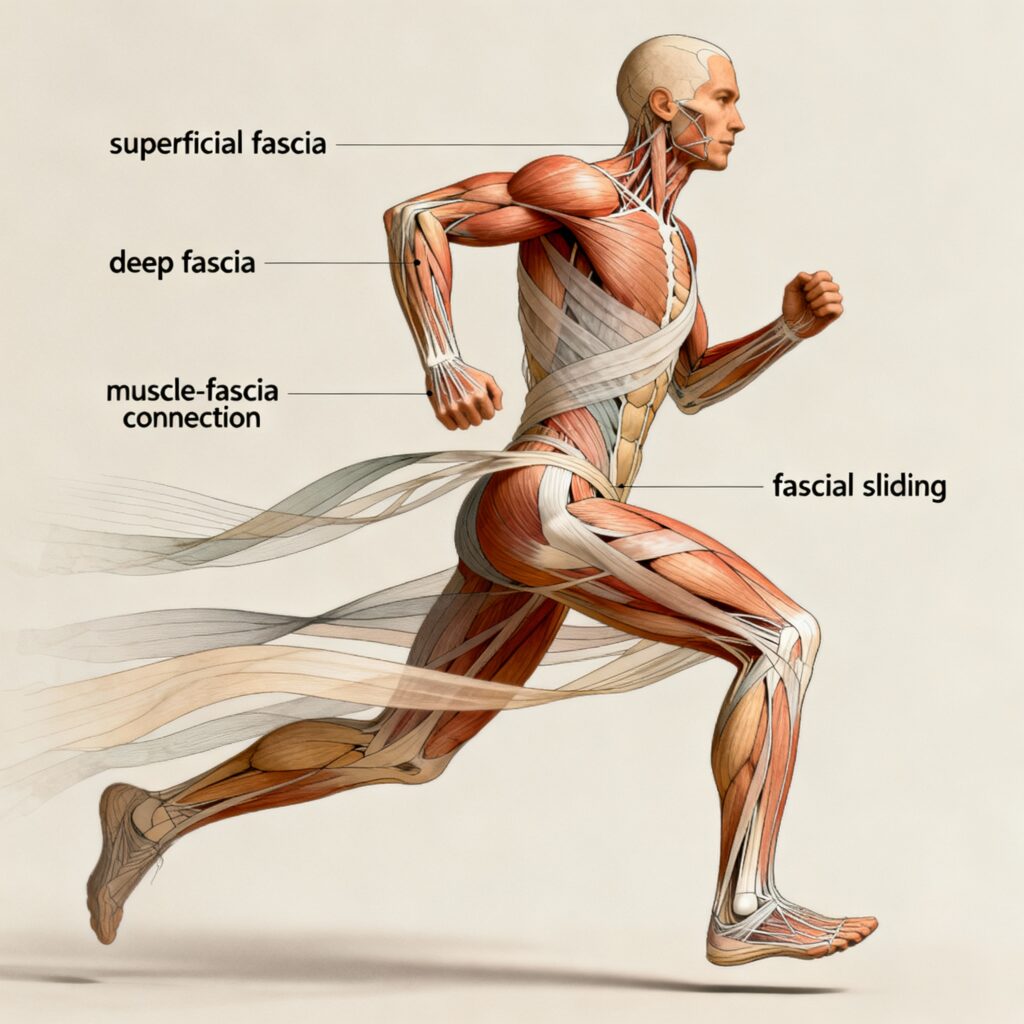
Fascia is the connective tissue that wraps around every muscle, bone, nerve, and organ in your body. Think of it as a three-dimensional spider web that holds everything together and transmits force throughout your entire system. Recent fascia research has revealed that this system is far more complex and integrated than previously understood.

When fascia is healthy:

  • Movement is fluid
  • Strength transfers efficiently
  • Pain is minimal
  • Recovery is faster

When fascia is restricted, compressed, or imbalanced:

  • Pain shows up (often far from the actual problem)
  • Movement feels stiff or limited
  • Strength doesn’t translate to function
  • Injuries keep recurring

Here’s the kicker: Most traditional fitness and therapy approaches completely ignore fascia. They focus on muscles in isolation, which is like trying to fix a tangled fishing net by pulling on one strand at a time.

It doesn’t work.

The Problem with Muscle-Only Thinking

Muscle-focused training operates on a flawed assumption: strengthen individual muscles, and the body will function better.

But your body doesn’t move muscle by muscle. It moves through fascial chains—long, continuous lines of connective tissue that link your foot to your head, your shoulder to your hip, your breath to your posture.

When you train muscles in isolation without respecting its fascia links:

  • You create imbalances (strong quads, weak glutes = knee pain)
  • You miss the connections that create real-world function
  • You reinforce compensation patterns (your body cheats around restrictions instead of fixing them)

Example: You do endless crunches to “strengthen your core,” but your lower back still hurts. Why? Because isolated abs don’t integrate with your fascial system. Your body compensates, and the pain persists.

Fascia training addresses the system—not just symptoms.

How Fascia Training Changes Everything

Fascia training isn’t about adding a foam roller to your routine and calling it a day. It’s a complete shift in how you approach movement, recovery, and long-term health.

This is the foundation of holistic exercise and fitness training at SolCore Fitness & Therapy.

Here’s what fascia-focused training looks like:

1. Decompression Over Compression

Most exercises compress joints. Fascia training creates space—through techniques like ELDOA (spinal decompression exercises)—so your joints can move freely and without pain.

2. Integration Over Isolation

Instead of training one muscle at a time, you train fascial chains. This improves coordination, balance, and real-world strength (not just gym strength).

3. Adaptation Over Repetition

Your fascia adapts to intelligent loading. That means progression matters more than volume. Doing 100 reps of the same thing won’t change your fascia. Challenging your system in new ways will.

4. Awareness Over Autopilot

Fascia training requires body literacy—understanding what you feel, why you feel it, and how to adjust. You’re not just following orders. You’re learning your body’s language.

5. Time Over Quick Fixes

Fascia remodels slowly. Real change takes 90 days minimum. Anyone promising 6-week transformations is lying to you.

This is why holistic osteopathic training at SolCore Fitness & Therapy works when other programs don’t. We don’t guess. We don’t isolate. We work with your fascial system to create lasting change.

The 5 Principles Missing From Your Current Program

Most fitness programs fail because they skip these five foundational pillars:

Pillar 1: Fascia Matters More Than Muscles

Your body isn’t a collection of isolated muscles—it’s an interconnected fascial system. When you ignore fascia, pain keeps returning, flexibility doesn’t improve, and injuries recur. Train the system, not just the parts.

Pillar 2: The Way Is Through—Adaptation Over Avoidance

Intelligent challenge creates adaptation. Avoidance creates protection. Your body needs progressive loading and appropriate stress to build resilience—not rest and isolation that lead to weakness and compensation.

Pillar 3: Progression Over Quick Fixes

Fascia remodels slowly. Real tissue change takes 3-6 months, not 6 weeks. Anyone promising instant transformations is lying to you. Sustainable results require time, consistency, and intelligent progression.

Pillar 4: Body Relationship Over Quick-Fix Mentality

Instead of depending on practitioners to “fix” you, learn to read your body’s signals. Develop body literacy—the ability to understand what you feel, why you feel it, and how to respond. This is empowerment, not dependence.

Pillar 5: Holistic Osteopathic Training vs. Standard Fitness/Therapy

Gyms isolate muscles. PT clinics treat symptoms. Yoga studios offer general movement. Holistic osteopathic training integrates manual therapy, fascia-focused exercise, and progressive loading to address your entire system.

Want the complete framework? Download our free guide: The Fascia Fix Framework: 5 Pillars to Transform How You Move, Recover, and Live

What This Means for You

If you’re dealing with:

  • Chronic pain that won’t go away
  • Stiffness that limits your daily activities
  • Injuries that keep recurring
  • Frustration that traditional methods aren’t working

…then fascia training is what you’ve been missing.

This isn’t about adding another stretch or doing more reps. It’s about understanding how your body actually works—as an interconnected system—and training it accordingly.

At SolCore Fitness & Therapy, we don’t just teach exercises. We teach you how to read your body, work with your fascia, and build a foundation for long-term health and independence.

Ready to experience the difference?

👉 Download The Fascia Fix Framework – Learn the 5 principles that will transform how you move, recover, and live.

👉 Book a Free Consultation – Let’s talk about your specific needs and how fascia-focused training can help.


Conclusion

Your body is smarter than any workout program. It’s designed to move, adapt, and heal—when you give it the right inputs.

Stop training muscles. Start training fascia.

The difference is everything.

Follow the Thread—Where Movement, Fascia, and Freedom Align
Find more insight, reflection, and fascia-informed care:

Facebook

Bluesky

Pinterest

Instagram

YouTube

LinkedIn

Breast Cancer Awareness: Fascia, Movement, and Healing

breast cancer awareness

Breast cancer awareness is more than checkups—it’s about moving well, healing fully, and supporting quality of life beyond treatment. Fascia, often overlooked, is the connective tissue that holds the body together. Keeping it healthy with the right movement is crucial before, during, and after cancer therapy.

Understanding Fascia and Why It Matters

What Is Fascia and How Does It Affect Recovery?

  • Fascia forms a network through muscles, organs, and nerves. Cancer therapy often causes tightness, scarring, or pain by affecting the fascia in the chest, shoulders, and arms.
  • Scientific reviews confirm that gentle movement and myofascial release help restore comfort and motion, reduce pain, and decrease the risk of complications like lymphedema after surgery or radiation.

Evidence-Backed Movement Strategies

  • Leading cancer clinics and physical therapists recommend progressive, supervised exercise and mindful stretching for recovery—never “push through pain,” always “restore with patience”.
  • Mobility routines—such as wall slides or open-arm postures—are safe post-clearance from healthcare providers and are part of modern rehab protocols.

Practical Daily Habits

  • Start with short walks and easy chest, shoulder, and arm stretches, increasing only as tolerated and guided by professionals.
  • Focus on posture and breathwork to help create space and gentle movement around surgical or radiation areas.
  • Drink water and eat nourishing food for tissue recovery and resilience.

Resources and Further Learning

For a comprehensive approach to movement and long-term health, explore our Holistic Guides: Holistic Guides

Authoritative External Source:

Follow the Thread—Where Movement, Fascia, and Freedom Align
Find more insight, reflection, and fascia-informed care:

Facebook

Bluesky

Pinterest

Instagram

YouTube

LinkedIn

Labor Day—From Summer Adventure to Year-Round Strength

Adults working out in a fitness studio and then in fall and winter activities for Labor Day fitness routine

Labor Day fitness routine isn’t about forcing a big “reset”—it’s about transforming all the gains from your summer adventures into strength, mobility, and vitality for every season ahead. Summer fills the calendar with hiking, long days outside, spontaneous games, and late-evening walks. But as Labor Day draws near, it’s time to move with intention. At SolCore, we know the secret isn’t in trends or quick fixes. It’s a holistic, fascia-focused approach rooted in osteopathic science that prepares the body for fall’s best adventures—and next year’s too.

Ready to Move Into Fall?

The weeks after Labor Day aren’t about doing less, but about moving with intention. Fall in Santa Fe is its own invitation: the hiking trails call, the aspens change, and soon enough it’s time for skiing, snowshoeing, or simply enjoying crisp mornings. But to actually enjoy these activities (and not get sidelined by pain, tightness, or fatigue), the real difference comes from building a program that understands the body’s structure—how it actually moves, adapts, and needs support as the seasons change.

A traditional routine might throw you into generic circuits or treadmill marches. But a holistic, osteopathic, and fascia-focused approach looks at your entire body as an integrated system. This means:

  • Restoring balance where summer’s adventures left some areas overworked and others neglected.
  • Addressing fascial tightness from drives, hikes, or even lounging.
  • Building functional strength and mobility directly to support what you love outdoors—so hiking, skiing, or a simple walk is easier and more enjoyable.

For a deeper dive into how a holistic program can transform your movement year-round, check out our Holistic Exercises and Fitness Program guide.

Building Strength for Every Adventure—Beginning Now

What you start this September sets the table for every bit of joy, freedom, and resilience you’ll feel in the coming months.

  • Want to feel great on snowy trails? Start by opening hips, knees, ankles and core now.
  • Planning long hikes under golden aspens? A strong, supple back and a breath-aware routine are your best gear.
  • Eyeing travel or winter play with grandkids? A holistic, fascia-first regimen will carry you through it all, helping you move better for longer.

By focusing on intentional structure, awareness, and practical mobility—rather than punishing reps or empty “grind” routines—you give your body the tools to keep saying YES to life, no matter the weather.

For guidance on staying fit no matter the season, check these Mayo Clinic tips for staying active year-round.

How to Transition This Labor Day

Labor Day isn’t just the end of summer—it’s your invitation to move into fall and winter with purpose, building the underlying strength and mobility that powers every hike, ski, or backyard game ahead. If you’re ready to make these months your foundation (and not just a “reset”), the SolCore approach is distinct: holistic, osteopathic-driven, and fascia-focused—all designed for real people, real change, real fun.

Follow the Thread—Where Movement, Fascia, and Freedom Align
Find more insight, reflection, and fascia-informed care:

LinkedIn

Facebook

Bluesky

Pinterest

Instagram

YouTube

Intention in Movement: Why How You Move Matters More Than Just Moving

Young woman practicing intentional movement in a bright studio, highlighting body awareness and fascia-focused control

We live in a world that tells us “just move.” And while movement is better than doing nothing, most people don’t realize how much intention in movement changes the outcome. They go through the motions — lift, stretch, sweat — but without any purpose guiding it. Over time, their body reflects that.

It’s not just about getting through your workout. It’s about what your body learns while doing it.

They plateau. They get stiff again. They end up injured, frustrated, or just plain confused about why they’re not getting results. That’s because movement without intention doesn’t build a better body — it just rehearses your current pattern.

What Is Intention in Movement?

Intention means you’re not just moving for movement’s sake — you’re moving with a purpose. That might be to decompress your spine, to support your posture, or to re-pattern your fascia. Intention gives your nervous system something to organize around.

This is where fascia-based, osteopathic movement shines. Because in this approach, every exercise is a conversation with your structure. You’re not just working muscles — you’re communicating with your body’s connective tissue, joints, and postural systems.


Intention vs. Repetition

Let’s say you do a hamstring stretch every day. If you’re doing it just to “get it done,” you’ll likely stay stuck. But if you approach that same stretch with the intention to open specific lines of tension in your fascia — now your brain is involved. Your whole body starts to change.

Repetition without intention just reinforces compensation.
Repetition with intention creates transformation.


How We Apply This at SolCore Fitness

Every session here — whether it’s a private therapy session or a group training class — is built around this principle. Intention is embedded into everything we do.

That includes:

  • Postural assessments before prescribing movement
  • Targeted fascial and joint techniques (like ELDOA) to decompress and realign
  • Teaching you how to feel what’s working, not just how to sweat

We don’t throw random exercises at a wall to see what sticks. We teach you how to move better so you can feel better.


What Happens When You Move With Intention?

  • You get stronger, but with freedom instead of stiffness
  • You become more resilient — fewer injuries, better energy
  • You notice a shift not just in your body, but in how you feel mentally
  • You learn what your body actually needs (and stop following generic plans)

Final Thoughts

Your body is always adapting — the question is, what is it adapting to? If you train without intention, you stay in the same loop. But when you move with clarity and purpose, you rewire your system from the inside out.

“As multiple neuroscience studies have shown, intention activates specific brain networks before movement even begins — reshaping both perception and performance.”

This is what our holistic training is built on.
If you’re tired of going through the motions, maybe it’s time to shift how you move — and why.

Want to move with more purpose and feel the difference for yourself?
At SolCore, we help you rebuild your body from the inside out — using precise movement, osteopathic techniques, and intentional training built around you.

book a consult to start moving forward — intentionally.

Follow the Thread—Where Movement, Fascia, and Freedom Align

Find more insight, reflection, and fascia-informed care across the platforms where we stay connected:

Facebook

Blue Sky

Pinterest

Instagram

Youtube

Linkedin