Zone 2 cardio is getting a lot of attention lately—and for good reason. But this isn’t just another fitness trend. If used properly, Zone 2 cardio can become the foundation of your long-term health, energy, and recovery.
Let’s break it down and show you how to make Zone 2 part of a complete, fascia-informed training approach—not just another checkbox in your routine.

Click the image to watch the video
What Is Zone 2 Cardio?
Zone 2 is the second level in a 5-zone cardiovascular scale, where your body primarily uses fat and oxygen (aerobic metabolism) to fuel movement.
It sits between gentle movement and high-intensity exercise, typically falling between 60–70% of your max heart rate.
Not sure what that means?
Start with a basic estimate: 220 - your age = max heart rate.
Then calculate 60–70% of that number.
More precise formulas exist, but the important thing is to start where you are and listen to your body.
✅ A heart rate monitor (Apple Watch, Garmin, etc.) can help
✅ You should still be able to talk comfortably while training (aka the “talk test”)
✅ You may still breathe mostly through your nose
Why Zone 2 Cardio Works So Well
Zone 2 improves how efficiently your body uses oxygen, delivers nutrients, and clears waste.
Here’s what you gain:
- Stronger heart and lungs
- More mitochondria (cellular energy factories)
- Better capillary density (circulation)
- Faster recovery between workouts
- A solid base for strength or higher-intensity training
If you’ve ever jumped into HIIT, CrossFit, or intense lifting without seeing results, it’s often because your foundation was missing.
Zone 2 is that missing piece.
The Missing Link: Structure and Posture
But here’s the part most people miss: your structure matters just as much as your heart rate.
If your posture is collapsed—rounded shoulders, forward head, restricted breathing—you’re limiting the ability of your lungs and heart to perform.
And that can reduce the effectiveness of even a perfect Zone 2 session.
That’s why we integrate corrective and structural work into all our programming at SolCore Fitness.
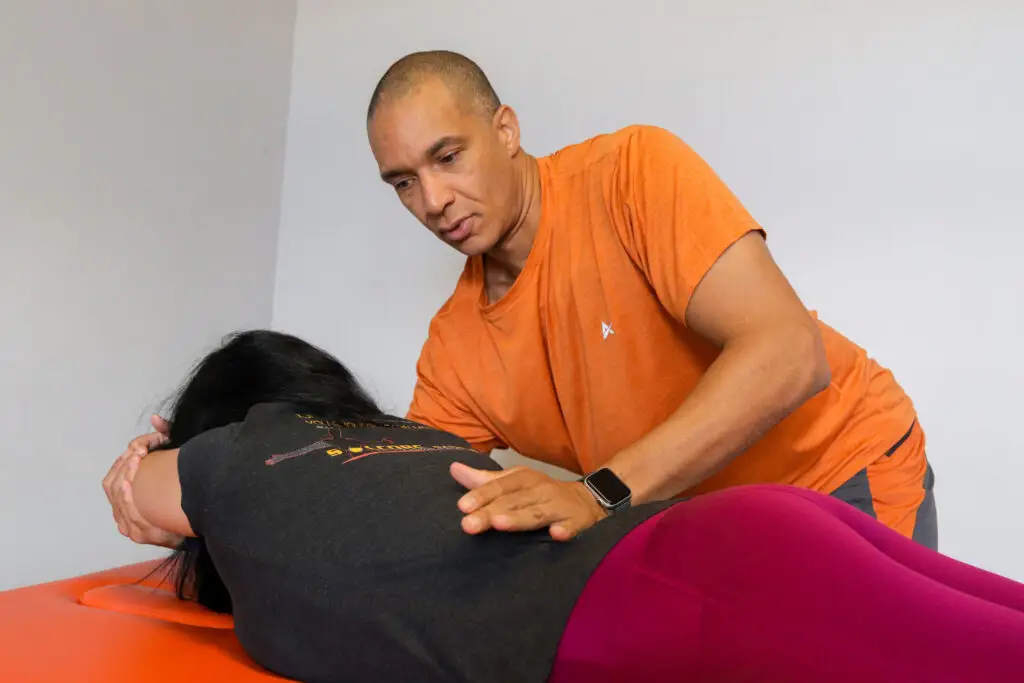
When you combine Zone 2 with myofascial stretching, segmental strengthening, and ELDOA techniques, you unlock the full benefit of cardio.
Explore how ELDOA exercises can open space in your spine and thorax to support better breathing and recovery.
How to Build Your Zone 2 Routine
- Start with Zone 1
If you’re new to cardio or unsure of your baseline, begin with lower-intensity Zone 1 work and good posture habits.
Let your body adapt before pushing harder. - Dial in your structure
Use corrective exercise and mobility work—like Global Strengthening and postural realignment—to prepare your body for regular training stress. - Progress gradually
- Begin with 45-minute sessions
- Aim to increase duration to 60–90 minutes over time
- Stay consistent and let your body adapt over weeks—not days
Don’t Skip Corrective Work
Even walking puts thousands of pounds of force through your joints over the course of 10,000 steps.
Without corrective exercise, those forces accumulate and degrade performance—especially in an unbalanced body.
Every Zone 2 session should be followed by realignment and decompression work, not just foam rolling or massage.
Corrective support ensures that:
- Muscles recover efficiently
- Fascia maintains healthy tone and hydration
- You prevent breakdown while building endurance
Final Thoughts: Periodization Is Key
Zone 2 isn’t meant to be a permanent state. It’s a phase in a smart, periodized plan.
You cycle between:
- Structure + Zone 1
- Structure + Zone 2
- Corrective + Recovery
- And eventually, higher intensities with full preparation
This is how you train for vitality, not just fitness.
Want support?
“Want to go deeper? Explore our Circulatory and Respiratory System Exercises designed to strengthen breathing and circulation.”

it’s not just working out, it’s building a foundation for a better life.
Find out more @